Military Sexual Assault Defense Lawyer
An Article 120 allegation is one of the most serious charges a service member can face. Careers, liberty, and lifelong registration consequences are at stake from the moment an investigation begins. Korody Law has defended service members against military sexual assault charges across every branch — from initial NCIS/CID/OSI investigation through court-martial and beyond. We start on your defense immediately. The earlier you engage counsel, the more options you have.
Military law enforcement begins building its case long before charges are filed. Early statements, consented searches, and device disclosures are the most common ways service members damage their own defense. Do not speak to NCIS, CID, OSI, or CGIS without counsel. Do not respond to calls or texts from the alleged victim — these may be recorded at law enforcement's direction. Contact Korody Law immediately.
On This Page
- What Is Article 120 UCMJ?
- What to Do First — Protecting Your Rights from Day One
- How Article 120 Cases Move Through the System
- The Political Environment — Why Fair Defense Matters More Than Ever
- Core Defense Themes in Article 120 Cases
- Digital Evidence, Forensics, and Expert Strategy
- Collateral Consequences Beyond Trial
- Why Korody Law for Article 120 Defense
- Frequently Asked Questions
- Related Practice Areas
What Is Article 120 UCMJ?
Article 120 of the Uniform Code of Military Justice covers a broad range of sexual offenses, including sexual assault, rape, and abusive sexual contact. Separate but closely related provisions govern sexual offenses involving minors (Article 120b) and other sexual misconduct (Article 120c). Together, these articles create one of the most aggressively prosecuted categories of military criminal law.
The elements of Article 120 offenses center on the absence of consent and the presence of force, threat, or incapacitation. The government does not need physical injury evidence to prosecute — allegations alone, supported by the alleged victim's testimony, can and do result in referral to court-martial. This means the credibility of the alleged victim, the reliability of the investigation, and the strength of your defense evidence are the decisive battlegrounds in most Article 120 cases.
| Article | Offense | Maximum Punishment |
|---|---|---|
| Article 120 | Rape | Dishonorable discharge, forfeiture of all pay, confinement for life |
| Article 120 | Sexual Assault | Dishonorable discharge, forfeiture of all pay, confinement up to 30 years |
| Article 120 | Aggravated Sexual Contact | Dishonorable discharge, forfeiture of all pay, confinement up to 20 years |
| Article 120 | Abusive Sexual Contact | Dishonorable discharge, forfeiture of all pay, confinement up to 7 years |
| Article 120b | Sexual Assault of a Minor | Dishonorable discharge, mandatory sex offender registration, confinement |
| Article 120c | Indecent Viewing / Recording / Broadcasting | Dishonorable discharge, confinement up to 1 year |
A conviction under Article 120 also carries mandatory sex offender registration requirements — a consequence that follows the service member for life, long after any sentence is served. There is no such thing as an Article 120 case that does not require the most aggressive, prepared, and experienced defense possible.
What to Do First — Protecting Your Rights from Day One
The most damaging mistakes in Article 120 cases happen in the first 24–72 hours. Before you speak to anyone — including your chain of command, fellow service members, or assigned military counsel — there are non-negotiable steps you must take immediately.
① No Statements
Do not make any statements to NCIS, CID, OSI, CGIS, your commanding officer, the XO, the command master chief, fellow service members, or anyone else. Statements made in the investigation phase are routinely used as the foundation of the government's case at trial. Even statements that seem to help you can be taken out of context. You have the right to remain silent — exercise it.
② Watch for Controlled Communication
Law enforcement routinely coordinates with the alleged victim to place recorded phone calls or send monitored text messages to the accused, seeking admissions or apologies. If the alleged victim contacts you — by any means, at any time — do not respond. Do not call back. Do not text. Hang up. Even an expression of concern or an apology can be construed as an admission of guilt.
③ Refuse All Consent Searches
Do not consent to the search of your phone, computer, vehicle, barracks room, home, or cloud accounts. Investigators may ask casually, frame it as routine, or imply that refusing looks suspicious. It does not. You have the right to refuse consent. Require legal process — a warrant or lawful order — for any search. Do not hand over your device "just to show nothing happened."
④ Preserve Your Own Evidence
Preserve — but do not delete — all relevant communications: text messages, DMs, social media exchanges, call logs, photos, videos, emails, and location data. Screenshot and back up anything that shows context, consent, or inconsistency in the alleged victim's account. Identify witnesses who observed relevant events and preserve their contact information. Do not destroy or alter anything.
⑤ Comply with Restrictions — Exactly
If you have been issued a Military Protective Order (MPO) or other no-contact or geographic restriction, comply with it precisely. Violations can result in additional UCMJ charges independent of the underlying allegation — and can severely damage your credibility before a court-martial panel.
⑥ Retain Civilian Defense Counsel
Your detailed military defense counsel is a JAG officer — often a junior attorney with limited Article 120 trial experience. An experienced civilian military defense lawyer brings deeper case-building capacity, investigation challenge experience, expert witness strategy, and the undivided attention your case demands. Retain experienced counsel before you make any decision.
How Article 120 Cases Move Through the System
Understanding the pipeline from investigation to trial is essential to understanding where your defense can be most effective. Article 120 cases are not like other UCMJ matters — they are subject to special oversight and mandatory review processes that affect timing, charging, and strategy.
-
Military Law Enforcement Investigation (NCIS / CID / OSI / CGIS)
The investigation is typically triggered by a report to the Sexual Assault Response Coordinator (SARC), law enforcement, or the chain of command. Investigators conduct victim interviews, collect physical and digital evidence, attempt to interview the accused, and build the government's initial case narrative. This is where the most critical defense errors occur. Early engagement of counsel — before you speak to anyone — can prevent the government from building its case on your own words. Defense work at this stage includes challenging investigative methods, identifying omitted witnesses, and preserving defense evidence.
-
Office of Special Trial Counsel (OSTC) Review and Charging Decision
All allegations of sexual assault under Article 120 must now be reviewed by the Office of Special Trial Counsel (OSTC) — a specialized military prosecution body created to centralize Article 120 charging decisions. The OSTC reviews the investigative package and decides whether to charge the case, what charges to prefer, and how to proceed. Early engagement with the OSTC by experienced defense counsel can, in some cases, deter referral entirely. A well-constructed defense memorandum submitted before the OSTC makes its charging decision can shape the outcome before a single charge sheet is signed.
-
Article 32 Preliminary Hearing
After charges are preferred, an Article 32 preliminary hearing is held to determine whether there is probable cause to refer the case to a general court-martial. Although the Article 32 is not a trial, it is a critical proceeding. Witnesses testify under oath. Testimony is locked in. Weaknesses in the government's case are exposed. Cross-examination at the Article 32 can materially alter the case posture — affecting whether charges are referred, reduced, or dismissed. The Article 32 should never be waived without extensive discussion with counsel. We treat the Article 32 as the first phase of trial, not a preliminary formality.
-
Pre-Trial Motions and Litigation
Before trial, the defense files motions addressing the admissibility of evidence, the constitutionality of the investigation, the scope of Mil. R. Evid. 412 (rape shield), expert witness qualifications, and a range of other issues that can fundamentally shape what the panel hears. Motions practice in Article 120 cases is sophisticated and consequential. Winning a key motion — suppressing an illegal search or excluding unreliable forensic evidence — can change the entire trajectory of a case.
-
Court-Martial Trial
Article 120 cases are tried before a panel of military officers (and, at the accused's election, enlisted members). The government bears the burden of proving every element beyond a reasonable doubt. Defense strategy at trial is built around the themes developed throughout the investigation, Article 32, and motions phases — attacking credibility, challenging forensic reliability, presenting affirmative evidence, and controlling the narrative the panel uses to evaluate the evidence. Trial preparation for an Article 120 case requires months of disciplined work, not weeks.
-
Sentencing and Post-Trial Review
If convicted, the defense presents mitigation and extenuation evidence to minimize the sentence. Post-trial review by the convening authority and, in certain cases, the Court of Criminal Appeals (CCA) and the Court of Appeals for the Armed Forces (CAAF) may provide avenues for relief. A well-preserved trial record is the foundation for all appellate remedies. Even in cases that result in conviction, post-trial advocacy can materially reduce the sentence and its long-term consequences.
The Political Environment — Why Fair Defense Matters More Than Ever
Military sexual assault prosecution does not occur in a political vacuum. For years, Congress, the Department of Defense, and senior military leaders have faced intense scrutiny over the handling of sexual assault within the armed forces. The result is an institutional environment in which military commanders — and now the OSTC — face significant pressure to refer Article 120 cases to court-martial even when the evidence is weak, inconsistent, or heavily one-sided.
This political pressure percolates through every level of the system. It shapes charging decisions. It influences how investigators approach cases. And in some cases, it reaches the court-martial panel itself — service members who have been exposed to years of institutional messaging about sexual assault in the military. The accused's right to a fair trial and the presumption of innocence must be actively defended — not assumed.
The False Allegation Reality
The FBI has estimated that approximately 8% of sexual assault reports are false. Many experts believe the rate is higher in the military community — an environment where reporting is incentivized, transferring units is facilitated, and personal circumstances can create powerful motives to fabricate or exaggerate. We begin every Article 120 defense by presuming that every element of the alleged victim's account requires independent verification. We find inconsistencies. We identify motives to fabricate. We expose investigation failures.
Tunnel Vision Investigations
Military sexual assault investigations are frequently conducted with a victim-centric approach that can result in tunnel vision — investigators focus on evidence that confirms the allegation and overlook or minimize evidence that contradicts it. Witnesses who do not support the government's narrative may not be interviewed. Exculpatory digital evidence may be deprioritized. Our attorneys scrutinize every investigative step, identify what was omitted, and expose those gaps at the Article 32, in motions, and at trial.
OSTC and Prosecutorial Pressure
The creation of the OSTC centralized Article 120 prosecutorial authority and removed charging decisions from local commanders — but it did not remove political pressure. OSTC prosecutors are specialized and experienced. Defense counsel must match that specialization. We have defended cases before OSTC referral, engaged OSTC directly with pre-charge defense submissions, and tried OSTC-prosecuted cases to acquittal. Knowing how OSTC operates is a core competency for Article 120 defense.
Korody Law's approach: We start with the presumption that every element of the alleged victim's account requires independent verification — and then we work backward from the evidence. We find inconsistencies in statements. We identify motives to fabricate. We attack the investigation. We expose the truth. We zealously defend our clients.
Core Defense Themes in Article 120 Cases
Every Article 120 case is fact-specific — but successful defenses are built around evidence-based themes rather than conjecture or character. Here are the defense themes that most frequently determine outcomes in military sexual assault cases:
Consent — Context and Communications
- Pre-event communications establishing consensual context (texts, DMs, social media)
- Post-event communications inconsistent with the allegation of non-consent
- Prior relationship and established patterns of interaction
- Behavior during and after the alleged incident inconsistent with victimization
- Delayed reporting and changes in account over time
- Affirmative evidence of consent that the government's case ignores
Credibility and Inconsistency
- Internal inconsistencies across multiple statements to law enforcement
- Contradictions between the alleged victim's account and physical or digital evidence
- Witnesses who contradict the government's narrative
- Prior false allegations or false statements in other contexts
- Motive to fabricate — relationship disputes, disciplinary avoidance, personal benefit
- Failures of memory inconsistent with trauma research (where applicable)
Capacity and Intoxication
- Legal incapacity requires proof beyond "intoxicated" — the standard is a specific legal threshold
- Toxicology evidence: blood alcohol levels, timing, and behavioral observations
- Memory science: distinguishing genuine blackout from reconstructed memory
- Witness observations of alleged victim's behavior at the relevant time
- Exaggeration or fabrication of incapacitation as a post-hoc justification
Investigation Failures
- Witness interviews that were not conducted or were conducted inadequately
- Digital evidence that was not collected, preserved, or analyzed
- Forensic testing that was not requested or results that were misinterpreted
- Investigative bias — treating the alleged victim's account as established truth
- Failure to follow investigative leads that would have undermined the allegation
- Constitutional violations in searches, seizures, or interrogation
Defense strategy in Article 120 cases is not about attacking the alleged victim as a person. It is about rigorously testing whether the evidence actually proves — beyond a reasonable doubt — every element of every charge. That is the constitutional standard. We hold the government to it.
Digital Evidence, Forensics, and Expert Strategy
Article 120 cases are increasingly won or lost on digital evidence and expert testimony. The government's forensic narrative — if left unchallenged — can appear authoritative to a court-martial panel. Effective defense requires understanding what the science actually shows, identifying its limitations, and presenting that analysis through qualified experts.
Digital Evidence Strategy
- Text messages and DMs: Full thread context, deleted message recovery, timing, and tone — not government-selected excerpts
- Social media: Posts, reactions, and communications before and after the alleged incident that contradict the allegation
- Location and timeline data: GPS records, cell tower data, and app location history that place individuals at specific locations
- Photos and video: Metadata analysis, timestamp verification, and content context
- Dating app and third-party communications: Context for the nature of the relationship prior to the alleged assault
- Deleted evidence recovery: Defense-directed forensic review of government-collected devices for exculpatory material
Forensic and Expert Witness Strategy
- DNA evidence: DNA proves contact or presence — it does not resolve consent. We retain experts who can explain this distinction clearly to a panel
- Toxicology: Blood alcohol calculations, pharmacokinetics, and behavioral incapacity thresholds require expert analysis — not government shorthand
- Memory science: Research on trauma-affected memory, delayed disclosure, and reconstructed memory is contested and requires expert contextualization
- SANE examination findings: Physical examination findings are often non-specific and do not establish force or non-consent without expert interpretation
- Investigation methodology experts: Experts who can testify to deficiencies in how the investigation was conducted and what those deficiencies mean for reliability
Korody Law works with a network of qualified forensic experts — including digital forensics specialists, toxicologists, memory researchers, and SANE examination reviewers — to build a defense that matches the government's technical evidence with credible, independent expert analysis.
Collateral Consequences Beyond Trial
An Article 120 allegation begins driving consequences long before any court-martial verdict — and a conviction carries consequences that extend decades beyond any sentence. Defense strategy must account for every dimension of impact, not just the trial outcome.
Sex Offender Registration
A court-martial conviction for rape, sexual assault, or certain other Article 120 offenses carries mandatory sex offender registration requirements under federal and state law. Registration can be required for life, affecting where you can live, work, and travel. Fighting for acquittal — or for conviction on a lesser included offense that does not trigger registration — is a critical defense objective.
Administrative Separation / BOI
An Article 120 allegation can trigger administrative separation proceedings — even before trial and even if no charges are ultimately preferred. Officers may face a Board of Inquiry. Enlisted members may face an administrative separation board. These proceedings can result in involuntary separation, adverse characterization of service, and loss of benefits — independent of any court-martial outcome. (BOI defense →)
Security Clearance
An Article 120 allegation — even one that does not result in charges — can trigger security clearance suspension or revocation. Officers and enlisted members with TS/SCI clearances can lose their clearances, their billets, and their post-military careers in defense contracting as a result of allegations alone. Clearance adjudication is a parallel fight that must be managed alongside the criminal defense. (Clearance defense →)
Career and Promotion
Even when an Article 120 allegation does not result in conviction or separation, it can produce adverse fitness reports, unfavorable information files, and other administrative record entries that block promotion and damage career trajectory. Defense strategy must protect both the criminal record and the administrative record simultaneously.
Discharge Characterization
A conviction at court-martial for a serious Article 120 offense typically results in a dishonorable discharge — the military equivalent of a felony conviction. A dishonorable discharge strips VA benefits, GI Bill eligibility, home loan benefits, and can bar federal employment. Even a bad conduct discharge or general discharge under other than honorable conditions carries significant collateral consequences. Fighting for the best possible characterization of service is always a defense priority.
Professional and Civilian Consequences
A military sexual assault conviction — or even the allegation itself — can affect federal employment, professional licensing, law enforcement background checks, and civilian employment. For military members who are also licensed physicians, attorneys, nurses, or other professionals, an Article 120 allegation can trigger licensing board inquiries that must be handled in parallel with the military proceedings.
Why Korody Law for Article 120 Defense
Article 120 defense is not a practice area for generalists. It requires deep familiarity with the UCMJ, the OSTC process, the Article 32 framework, military rules of evidence, forensic science, and the political dynamics that shape how these cases are prosecuted. Korody Law brings all of it.
"Mr. Korody is by far one of the most talented and experienced military defense attorneys in the country. Every document, every conversation, every procedure, every single regulation will be scrutinized ten times. This man is a consummate professional and is a master of his craft."
— Former Navy Officer, Court-Martial Defense Client"With my case Mr. Korody built such an aggressive defense that the prosecutor recommended to my Commander the day before the board that I be retained and my administrative separation board be cancelled immediately."
— Service Member, Defense ClientWhat Sets Us Apart
- 70+ years combined JAG experience — including as prosecutors, military judges, and senior defense counsel
- We have defended Article 120 cases from the initial NCIS/CID/OSI/CGIS investigation through court-martial acquittal
- We have engaged OSTC directly with pre-charge defense submissions that deterred referral entirely
- We have won Article 120 cases involving sexual assault, rape, and abusive sexual contact — including cases most would have considered unwinnable
- We maintain a network of qualified forensic experts: toxicologists, digital forensics specialists, memory researchers, and SANE review experts
- We handle the full spectrum of collateral consequences: BOI defense, security clearance, administrative separation — not just the court-martial
- We represent clients at installations and bases worldwide — wherever you are stationed
Facing an Article 120 Allegation? Time Is Critical.
Every day without experienced defense counsel is a day the government spends building its case against you. Contact Korody Law now for a confidential consultation. Do not speak to investigators, do not respond to contact from the alleged victim, and do not consent to searches — until you have spoken with us.
Frequently Asked Questions
These are the most common questions we receive from service members who have just learned they are under investigation or have been charged under Article 120.
-
Almost never. Investigators are not neutral parties — their role is to build a case. Statements you make in an attempt to explain yourself can be taken out of context, combined with other evidence to construct admissions, or used to lock in a version of events that benefits the government. In most Article 120 investigations, the best course is to say nothing to investigators and let your attorney engage on your behalf. This is not an admission of guilt. It is the exercise of a constitutional right.
-
No. DNA can establish contact or presence — it does not establish the absence of consent, which is the legal issue in most Article 120 cases. The presence of the accused's DNA at a scene or on the alleged victim proves that physical contact occurred. It says nothing about whether that contact was consented to. Jurors and court-martial panel members sometimes conflate DNA with guilt — effective cross-examination and expert testimony are essential to correct that misunderstanding.
-
Yes. The government can — and does — prosecute Article 120 cases without the cooperation of the alleged victim, relying on prior statements, digital evidence, physical forensics, and other witness accounts. The OSTC has the authority and resources to build cases that do not depend on victim testimony at trial. This is why early defense work — preserving evidence, identifying witnesses, and developing counter-narratives — is essential regardless of what the alleged victim says or does after making the initial report.
-
The Office of Special Trial Counsel (OSTC) is a specialized military prosecution body with authority over all Article 120 and related sex offense charges. The OSTC was created to remove charging decisions from local commanders and centralize them with experienced military prosecutors. OSTC attorneys are specifically trained in Article 120 prosecution. An effective defense requires counsel who understands how OSTC evaluates cases, what arguments will resonate before referral, and how to match the OSTC's prosecutorial approach at every stage.
-
Almost never. Waiving the Article 32 eliminates a critical opportunity to lock in witness testimony, expose weaknesses in the government's case, and shape the case posture before trial. Even if the defense believes referral to court-martial is likely, the Article 32 provides invaluable discovery and a platform to begin building the trial defense. You should never waive the Article 32 without extensive discussion with experienced defense counsel who has reviewed the full case file.
-
Military Rule of Evidence 412 limits the admissibility of evidence about the alleged victim's prior sexual behavior or predisposition. However, it is not an absolute bar — there are specific exceptions, and evidence admissible under those exceptions can be critical to the defense. Navigating Mil. R. Evid. 412 requires experience with the applicable standards and the procedural requirements for offering such evidence. An attorney who is unfamiliar with this rule — or who fails to make timely and proper applications — can forfeit critical defense evidence.
-
A conviction for rape or sexual assault under Article 120 carries severe consequences: a dishonorable discharge (which is the equivalent of a felony conviction), forfeiture of all pay and allowances, confinement, and mandatory sex offender registration. Post-trial remedies include clemency requests to the convening authority, review by the Court of Criminal Appeals (CCA), and in appropriate cases, the Court of Appeals for the Armed Forces (CAAF) and the Supreme Court. A well-preserved trial record is the foundation for all appellate options.
-
Yes. An acquittal at court-martial does not bar subsequent administrative separation proceedings on the same underlying facts. Administrative proceedings operate under a lower standard of proof (preponderance of evidence), and the government can use evidence that may have been excluded at the court-martial. Officers may face a Board of Inquiry. Enlisted members may face an administrative separation board. Planning for the administrative case must begin simultaneously with — not after — the court-martial defense.
Related Practice Areas
Article 120 cases rarely exist in isolation. The allegations drive consequences across multiple simultaneous proceedings. Korody Law handles them all.
Article 32 Sexual Assault Defense
The Article 32 is your first strategic opportunity — not a formality. We treat it as the opening phase of trial.
View Article 32 Defense →NCIS Investigation Survival Guide
What to do — and what not to do — when NCIS knocks on your door. Early decisions are permanent decisions.
View NCIS Guide →Military Sex Offender Registration
Understanding the registration consequences of an Article 120 conviction and how defense strategy can mitigate them.
View Registration Guide →Board of Inquiry (BOI) Defense
Officers facing Article 120 allegations may simultaneously face a BOI. We handle both in an integrated strategy.
View BOI Defense →Administrative Separation Boards
Enlisted members may face ADSEP proceedings alongside or following court-martial. We defend both simultaneously.
View ADSEP Defense →Security Clearance Defense
Article 120 allegations routinely trigger clearance proceedings. This fight must run in parallel, not in sequence.
View Clearance Defense →Your Defense Starts Now.
Korody Law has defended service members against Article 120 allegations across every branch of service — from the first contact with investigators through court-martial acquittal. We fight the government. And we win. If you are facing an Article 120 investigation or charge, contact us now for a confidential consultation. There is no cost to speak with us.
Korody Law, P.A. · 630 West Adams Street, Suite 208, Jacksonville, FL 32204 · Worldwide Representation
NO STATEMENTS
If you are being accused of military sexual assault, don't make any statements to anyone.
WATCH FOR "CONTROLLED" CALL OR TEXT
Military law enforcement will have the alleged victim contact the suspect by text or phone to try and obtain a confession. Do not answer or respond.
DO NOT CONSENT TO ANY SEARCH
Do not consent to search of your home, car, cell phone or anything else.
Article 120 • UCMJ • Court-Martial Defense • Worldwide
Article 120 UCMJ Defense Lawyer
Article 120 cases are won or lost. The defense begins with exercising rights during the investigation by NCIS/CID/OSI/CGIS and gathering evidence and witnesses to refute the allegation of sexual assault. This page explains how Article 120 cases typically move from investigation to referral, how to defend them, and what to do early to protect your rights.
Call/Text: (904) 383-7261 • Jacksonville, FL • Military matters worldwide
What to Do First in an Article 120 Investigation
- No statements to investigators, command, friends, or “informal” interviewers before counsel.
- No consent searches of phone, devices, home, vehicle, cloud accounts, or DNA collection absent legal process.
- Preserve evidence: texts/DMs, call logs, location data, receipts, photos/video, witness names.
- No-contact compliance (MPO/restrictions) matters—violations can create new charges.
How Article 120 Cases Typically Move Through the System
1) Investigation
Investigations often center on early statements, digital evidence, and witness interviews. The government’s narrative forms early—defense work must start early.
2) Legal review / charging decisions
All allegations of sexual assault/Article 120 must be reviewed by the Office of Special Trial Counsel (OSTC). The OSTC will decide whether to charge the case. Early engagement by counsel with OSTC can deter it from charging the case.
3) Article 32 preliminary hearing (when applicable)
Article 32 is not a “mini-trial,” but it can lock in testimony, identify weaknesses, and shape the future negotiations or the trial. A disciplined approach can materially affect the case posture. It should not be waived without extensive discussion with counsel.
4) Motions / litigation / trial
Motions, expert issues, and admissibility disputes often determine what the factfinder actually hears. Defense planning should integrate cross-exam themes and evidentiary strategy.
Core Defense Themes in Article 120 Cases
Every case is fact-specific, but successful defenses often focus on evidence-based themes rather than conjecture:
- Timeline & context: what the messages, witnesses, and objective forensics actually show.
- Consent narrative disputes: communications before/after and conduct consistent with consent and capacity to consent.
- Capacity & intoxication: distinguishing intoxication, blackout, and legal incapacity and requireing reliable proof.
- Credibility and inconsistency: changes in story, contradictions, and missing corroboration.
- Investigation flaws: tunnel vision, omitted witnesses, misinterpreted forensics, missing investigative actions.
Digital Evidence, Forensics, and Experts
Digital evidence
- Texts/DMs and deleted-message context
- Location and timeline data (when available)
- Photos/video and metadata issues
- Social media spillover and third-party communications
Forensics & expert strategy
- What DNA can—and cannot—prove
- Toxicology and timing limitations
- Memory science issues in intoxication cases
- Cross-exam themes that properly frame the science
Collateral Consequences Beyond Trial
Article 120 allegations can drive consequences before trial and even without conviction: security clearance impact, duty restrictions, adverse evaluations, and administrative separation risk. Defense strategy should protect both the trial outcome and the administrative record.
FAQ
Should I talk to investigators to “clear it up”?
In most cases, no. Early statements can create admissions or inconsistencies that become central trial issues.
Does DNA automatically prove guilt?
DNA can show contact or presence. It usually does not resolve consent. Context and timelines still matter.
Can the process start even if the complainant won’t cooperate?
Yes. The government may proceed using other evidence such as digital communications and witness statements.
Related Pages
Facing an Article 120 allegation? The earlier you shape the record, the more options you preserve.
Request a confidential consultation or call/text (904) 383-7261.
Disclaimer: This page provides general information and is not legal advice for any specific case.
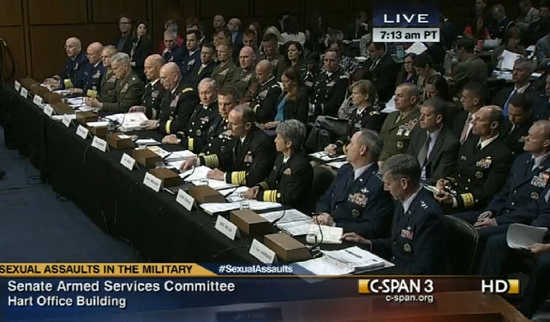
Look at this picture!
Look at how many high ranking military officers are gathered to answer for the “sexual assault epidemic” in the military. This has created an environment where military leaders, who control the discipline and court-martial system in the military, feel compelled to send even the most baseless cases to trial by court-martial because of political pressure. This political pressure to “solve” the military sexual assault epidemic then percolates down the ranks reaching those military members that will serve as the jury for a court-martial.
Korody Law fights back to ensure that any military member accused of sexual assault gets fair treatment.
YOUR BEST DEFENSE STARTS HERE
The FBI has estimated that 8% of all reports of sexual assault are false. We believe that the number is significantly higher in the military community. The number is likely higher in the military community because the military has made it extremely easy to make a report of sexual assault and build a system that incentivizes reporting sexual assault. A military member who reports a sexual assault is given a team to help them, the option to transfer units, and the ability to avoid punishment for their own misconduct. The military community is also an environment where an alleged victim can quickly feel pressure to provide a justification for what may have been a poor decision to cheat on a spouse or act in a way that lowers the member in the opinion in the eyes of others – in other words, because of the nature of the community, there are reasons for fabricating allegations of sexual assault to protect oneself.
Military investigators, prosecutors, and commanders are trained to assume that everything an alleged victim reports is truth. We start with the presumption that everything the alleged victim reported is false or exaggerated. And then we work to find inconsistencies in statements and with evidence to undermine the credibility of the alleged victim. We find motives to fabricate and lie. We attack the investigation. We expose the truth. We zealously defend our military clients.
We Fight The Government… And Win.
Military investigations. Federal indictments. Court-martial. Administrative Separation. Board of Inquiry. DHA Peer Review Hearings. Merchant Mariner credential actions. Security clearance revocations.
When Everything Is At Stake.
The government will take everything from you - life, liberty, happiness. Prosecutors build cases long before charges are filed.
Do not talk. Do not explain. Do not cooperate blindly.
Precision planning. Tactical execution. Controlled aggression.
We identify weaknesses in the government’s case and apply pressure where it matters most — whether the battlefield is federal court, a court-martial, a separation board, a white collar investigation, or a credential revocation proceeding.